In Sunday’s Chronicle, area businessman and former Kemah Mayor Bill King described problems with the rail line in The Medical Center area with which blogHOUSTON readers are very familiar:

- An at-grade alignment in a dense automobile and foot traffic corridor that has led to numerous accidents.
- Confusing signs and lights providing directions.
- Stray current problems that will have to be monitored for the life of the light rail, and may require millions of dollars’ worth of rehabilitation to prevent catastrophic structural failures.
King’s solution?
Elevate the rail, at least in the Med Center and other dense areas.
As King concedes, paying for such a good idea is the problem. Elevating the rail can drive two to five times higher, according to King. “Despite Metro’s multiple groundbreaking ceremonies,” he writes, “federal funds have yet to be approved in amounts sufficient to actually construct any portion of the rail line.”
King suggests one possible solution is federal “Fixed Guideway Rehabilitation” funding, which could provide up to 80% of the cost of elevating the rail line by the time plans were ready, which could drive the overall cost to METRO and area taxpayers down to amounts that might be required to mitigate stray-current issues anyway.
The entire op-ed is here. Please go give it a good read.

We have long thought that laying rail down busy traffic corridors does nothing for overall mobility in Houston, and agree with King that great transit systems in the world don’t do things this way. We would rather not have rail in Houston if this is the only system METRO’s leaders can come up with, due to its inadequacies, lack of impact on overall mobility, and significant cost to taxpayers.
We have friends in the rail debate who argue it’s important for Houston to move forward on rail as quickly as possible to set a precedent, however poor the plan, and fix any disastrous consequences later once a “rail culture” has taken hold. We have other friends in the debate who argue that rail is not a cost-effective solution for Houston because of the city’s density, and that existing and future rail plans should simply be scrapped.
We take a position somewhere in the middle. Our friend Tory Gattis has argued that a rail network that connects Houston’s major job centers/universities makes some sense. And that argument resonates to the extent that most serious people understand such a system needs to be aimed at future growth and needs (10, even 20 years down the road), since it’s hard to argue we have the population density at the moment to support that kind of system. In reality, we have just enough density in certain areas to create more traffic nightmares if we continue laying rail down busy streets. That’s why we should be talking about grade-separated rail (especially in denser areas) and connecting job centers inside the loop, with a view towards Houston’s future growth. The next phase following construction of a well-planned, inner-city network would be enhancing commuter options (Park and Ride, commuter rail, and the like) — since it doesn’t make much sense to enhance those options if your transit organization can’t get patrons to job centers effectively once they are inside the loop. Airports would be dead last on my list, given the distance involved, the cost, and the lack of immediate benefit to local taxpayers.
Obviously, constructing that sort of system would cost much more money than voters contemplated in the 2003 referendum (aspects of which METRO has disregarded anyway), and it shouldn’t be undertaken without a robust, honest* debate over costs and benefits long-term — and a vote. Unfortunately, we don’t tend to have those sorts of debates over transit in Houston. And that’s why Bill King’s comparatively modest proposal likely didn’t generate much more than a “harrumph” from Frank “Procurement Disaster” Wilson and METRO’s acolytes.
* For example, we are tired of reading METRO claims that the next phase of light-rail expansion will create 60,000 jobs.
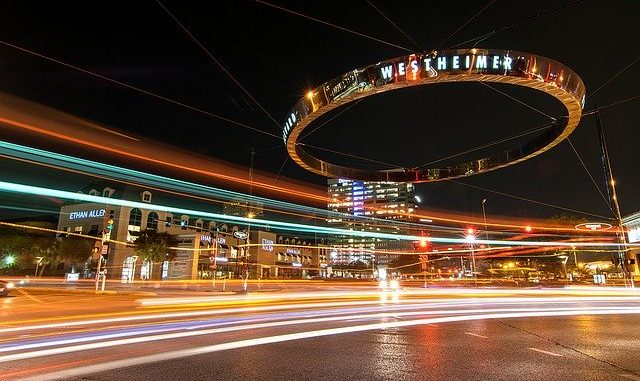
Photo of Med Center light rail/traffic sign from my personal flickr collection. Photo of a Chicago EL train by flickr user celikins, used via a Creative Commons license.
UPDATE (08/20/09): And here is the official “harrumph,” in the form of a letter to the Chronicle, which we are reposting in its entirety due to the unreliability of Chron archives and the fact this is a statement from a public official:
Elevating rail not practical
Bill King’s suggestion to reconstruct and elevate the existing light rail line through the Texas Medical Center (TMC) is an idea whose time has come